We teach the technique.
A short, age-appropriate demonstration helps learners use tools and materials with confidence.
 LEMONADEART STUDIO
Lemonade Guided Creative Learning

We teach one clear technique, invite real choices and document how each learner’s ideas develop. The learning goal can be shared; the artwork stays their own.
One skill. Many answers.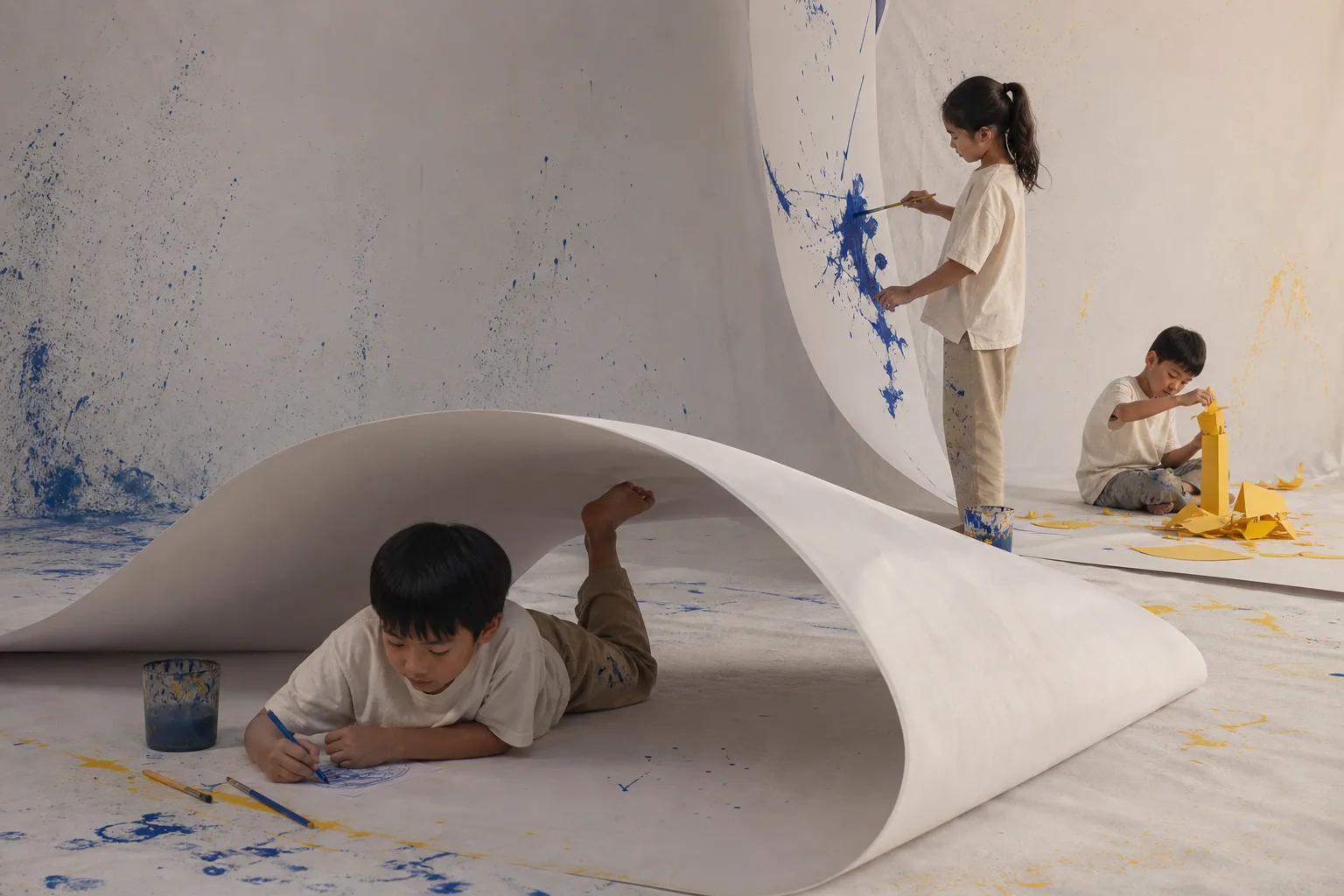
A short, age-appropriate demonstration helps learners use tools and materials with confidence.
Theme, colour, arrangement, texture and story stay open enough for a real point of view.
We notice a technique learned, a choice made, a problem revised and what could come next.
Three common approaches
This is a simple comparison, not a ranking. Strong teachers may combine more than one approach.
Atelier is not shorthand for “no teaching.” Reggio Emilia practice is intentional, relational and deeply documented. Read the official principles ↗
Clear boundaries, real choices
A familiar class rhythm
A clear rhythm makes the class feel safe and lets attention stay on the learner’s own ideas.
Look closely at an object, artwork or material.
Meet one useful technique or safety point.
Decide on colour, composition, texture or story.
Create independently, with support only when it helps.
Name a discovery and record how the work developed.
Research-informed, explained honestly
Guided Creative Learning is Lemonade’s own teaching approach. It is informed by established ideas; it is not a licensed system or a promise of guaranteed outcomes.
Guided play combines an adult learning goal with child choice and flexible support. The evidence is promising in some domains, mixed in others, and is not a direct test of Lemonade art classes.
Skene et al., 2022 review ↗Scaffolding means reducing a difficulty, showing one action or giving one prompt — then stepping back when the learner can continue.
Wood, Bruner & Ross, 1976 ↗Studio Thinking gives us language for craft, observation, persistence, expression, exploration and reflection — more useful than judging whether a picture is simply ‘nice’.
Harvard Project Zero ↗Reggio-inspired documentation values the child’s words, experiments and revisions alongside the finished work. It informs our planned Parent Studio, without implying Reggio certification.
Reggio Children values ↗Clear goals, meaningful choices, responsive support and reflection can belong in the same class.
What we will not claimThat one art method is scientifically proven to make every child more creative, confident or intelligent.
See it in a real class
Tell us the learner’s age, interests and location. We’ll discuss a suitable starting point and what a trial would include.
Book a free trial now!